
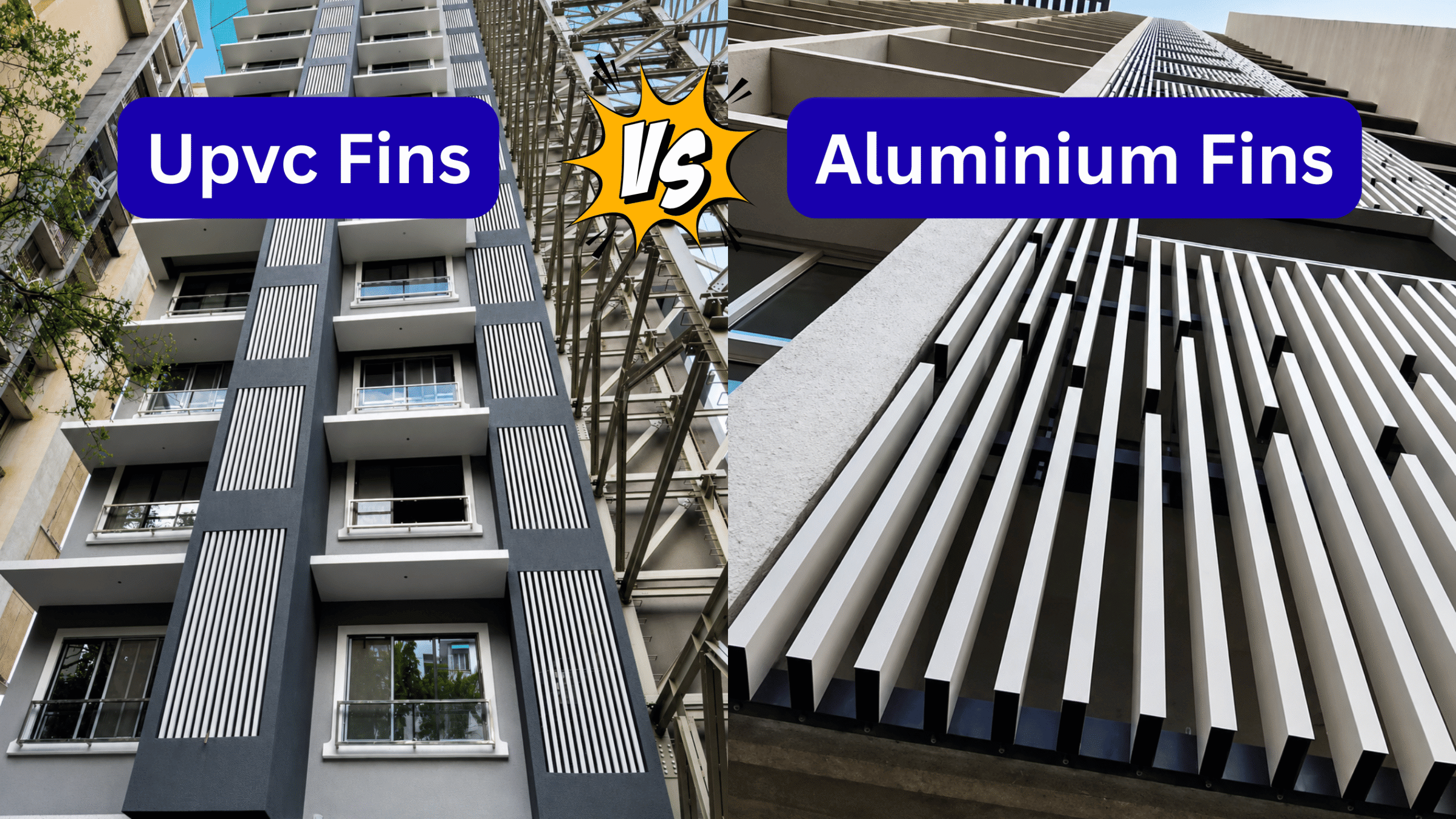
Choosing between uPVC fins and aluminium fins comes down to four things: cost, corrosion resistance, maintenance, and how the material holds up in Indian weather. For most residential towers, commercial facades, and parking areas across India, uPVC fins are lighter, corrosion-proof, and significantly more affordable than aluminium — with almost no upkeep. Aluminium still has its place on certain high-load or specialised structural applications, but for facade fins and louvers, uPVC usually wins on value.
Here’s the full comparison so you can decide with confidence.
Quick comparison: Upvc fins vs. Aluminium fins
| Factor | Upvc Fins | Aluminium Fins |
|---|---|---|
| Cost (supply) | Lower — budget-friendly | Higher |
| Corrosion / rust | Fully corrosion-proof | Can corrode in coastal/humid air |
| Maintenance | Near-zero; no painting | Periodic painting/polishing |
| Weight | Lightweight | Heavier |
| Colour fading | UV-stabilised, resists fading | Coating can fade over time |
| Best for | Facades, louvers, duct covers, parking | Heavy structural / load-bearing uses |
What are Upvc fins and aluminium fins?
Upvc fins are architectural facade elements made from unplasticised polyvinyl chloride — a rigid, weather-resistant material used widely in windows, pipes, and building products. As fins, they’re mounted on building exteriors for sun shading, ventilation, and elevation design.
Aluminium fins serve the same architectural purpose but are extruded from aluminium, then coated or anodised for finish and weather protection. They’ve traditionally been the default for facade louvers, which is why the comparison comes up so often.
Both do the same job visually. The difference is in how they perform and what they cost over the life of the building.
Cost comparison
Cost is usually the deciding factor for developers working at scale. Upvc fins carry a lower material and installation cost than aluminium, and because there’s no painting or polishing over the years, the lifetime cost advantage widens further.
When you buy Upvc fins directly from a manufacturer — with no distributor margin in between — the per-running-foot price is even more competitive. For large residential or commercial projects, that difference across thousands of running feet is substantial.
(For current Upvc fin rates, see our Upvc fins price guide or request a project-specific quote.)
Corrosion and coastal performance
This is where Upvc clearly separates from aluminium in the Indian context. uPVC fins do not rust, corrode, or react to salt air. In coastal cities like Mumbai and Chennai — and in humid conditions generally — this matters enormously.
Aluminium resists corrosion better than steel, but coatings can degrade, edges can oxidise, and coastal salinity accelerates wear. For a facade that faces the sea breeze every day, corrosion-proof uPVC removes an entire category of long-term risk.
Maintenance: painting, polishing, and fading
Upvc fins require almost no maintenance. There’s no painting, no polishing, and no repainting cycle. The colour runs through a UV-stabilised material, so it resists fading under harsh sun rather than sitting on top as a coating.
Aluminium fins, depending on their finish, may need periodic upkeep to keep the coating looking fresh — an ongoing cost and logistical task on tall facades.
Weight and installation
Upvc fins are lighter than aluminium, which simplifies handling and installation, especially on high facades and podium areas. Lighter components can also mean lower load considerations for certain mounting conditions. With precision bracket fixing and proper alignment, Upvc fins install cleanly across large elevations.
Lifespan and durability
Modern UV-stabilised uPVC fins are engineered for long-term durability — heat-resistant, rainproof, and humidity-resistant. Tested across India’s climate extremes, from Mumbai’s coastal humidity to Rajasthan’s heat and North India’s winters, quality Upvc holds its form and colour for years.
When does aluminium still make sense?
To be fair to both materials: aluminium can be the right call for applications with high structural or load-bearing demands, or where a specific metallic finish is architecturally required and budget is not the constraint. For purely decorative and functional facade fins, louvers, and duct covers, though, uPVC delivers the same look at a lower cost with far less upkeep.
Verdict: which should you choose?
For the majority of Indian projects — residential towers, commercial buildings, IT parks, hospitals, schools, and parking/podium areas — uPVC fins are the smarter choice: lower cost, corrosion-proof, virtually maintenance-free, and proven across Indian climates. Reserve aluminium for the specific cases where its structural or finish properties are genuinely required.
Frequently asked questions
Are Upvc fins as strong as aluminium fins? For facade and louver applications, quality UV-stabilised uPVC fins provide the durability and weather resistance the job needs. Aluminium’s higher structural strength matters mainly in load-bearing uses, which is not what facade fins are for.
Do Upvc fins fade in the sun? UV-stabilised uPVC fins are made to resist fading. The colour is part of the material rather than a surface coating, so they hold up well under strong Indian sun.
Which is cheaper, Upvc or aluminium fins? uPVC fins are generally cheaper on both supply and lifetime cost, since they need no painting or polishing. Buying direct from a manufacturer lowers the price further.
Are Upvc fins good for coastal cities? Yes. Because they’re fully corrosion-proof, uPVC fins are well suited to coastal and humid cities like Mumbai and Chennai where corrosion is a constant concern.
Planning a facade, louver, or duct-cover project? Elite Fins manufactures and installs custom Upvc fins in-house at our Mira Road, Maharashtra facility — 500+ colour options, custom profiles, and pan-India installation. Get a free project-specific quote or call +91 8450965094 and +91 9930724665.